A File · Indigenous Policy · Canada
The
Back
Office
The objective never changed. Only the costume.
The public argument keeps changing clothes. In 1969 it wore equality. In 2015 it wore compassion. In 2026 it wears public safety. Underneath, the sentence is the same one Canada has been administering since the Indian Act: end the distinct collective, remove the people, extinguish the title. This file follows that sentence through the office that has carried it, decade by decade, in the state's own words.
The door in
On July 22, 2026, Scott Gilmore became Principal Secretary to Prime Minister Mark Carney, the most senior political-staff post in the Prime Minister's Office. He had joined Carney's office in March 2025 as senior adviser on foreign, defence and security policy.
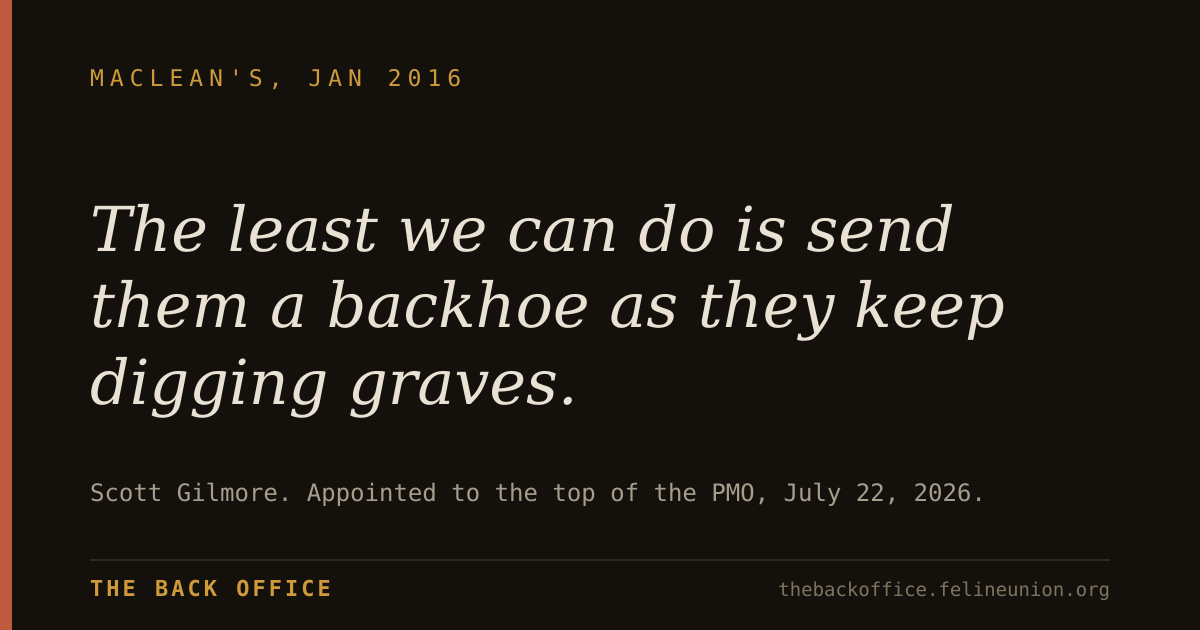
Ten years earlier, Gilmore had written in Maclean's that the way to end the violence in Canada's remote Indigenous communities was to help the people leave them, forever - and that failing that, the least Canada could do was send a backhoe as they kept digging graves.
The line is authentically his. It is not a fringe opinion held at a distance from power. It is the reasoning of the person now sitting at the top of the office that sets the Prime Minister's agenda. That is not a scandal about a bad tweet. It is a window onto a policy that has been running, under changing names, for a very long time.
The spine - one office, ten stations
1876
The founding instrument
Sold as protection and civilization
The Indian Act becomes federal law. Its purpose, stated openly at the time, is to manage Indigenous peoples toward disappearance as distinct nations: to "civilize," enfranchise, and absorb. Every later reform argues about the method. The objective is set here.
The policy analyst Russ Diabo, a Mohawk of Kahnawà:ke, puts it flatly: the federal objectives of assimilation and termination "have been central to the Indian Act since it became federal law in 1876, and these objectives remain very much alive in Canada today."
Source: Russ Diabo, Georgia Straight, Aug 7 2021
1969
The White Paper - termination as legislation
Sold as equality
The Trudeau government's Statement on Indian Policy proposes to end the separate legal status of "Indians" entirely: repeal the Indian Act, wind down the treaties, dissolve the reserve land base, and fold Indigenous people into the citizenry as individuals. It is framed as the removal of discrimination.
Diabo lists its objectives verbatim as the template everything after it inherits:
Assimilate First Nations. Remove legislative recognition. Neutralize constitutional status… Eliminate Reserve lands and extinguish Aboriginal Title. Dismantle Treaties.Russ Diabo, "Harper Launches Major First Nations Termination Plan," First Nations Strategic Bulletin (2012)
First Nations reject it outright. The White Paper is defeated in daylight. But defeat in public is not the end of a policy. It is the moment a policy goes indoors.
1973 – 1976
The back office - termination as administration
Sold as certainty and fairness
What could not pass as a bill is rebuilt as a procedure. In 1973 the Supreme Court's Calder decision forces Ottawa to concede that Aboriginal title is a real legal interest that survived European settlement. The government's response is not to honour it but to establish a desk to extinguish it by agreement.
The 1973 Statement on Claims of Indian and Inuit People originates the comprehensive land claims policy. In 1974 the Office of Native Claims is created inside the Department of Indian Affairs. The 1981 policy paper In All Fairness reaffirms the design. The government describes the machinery in its own words:
The primary thrust… was to obtain certainty… by negotiating an exchange of claims to undefined Aboriginal rights for a clearly defined package of rights and benefits.Crown–Indigenous Relations and Northern Affairs Canada, on the policy's genesis in the 1973 Statement
Read plainly: give up the title you were just told is real, and in return receive a defined list of things the state chooses to grant. This is the back office. It is where the objective of 1969 has lived, continuously, ever since.
Sources: RCAANC · Specific Claims Tribunal · In All Fairness (1981)
1975
James Bay - the template made real
Sold as modern partnership
The James Bay and Northern Quebec Agreement, Canada's first "modern treaty," puts the new machinery to work. In exchange for a hydro megaproject on their lands, the Cree and Inuit signatories agree to the extinguishment of their claims over the wider territory. The exchange-for-certainty model is no longer a policy paper. It is a signed precedent that the following fifty years of "modern treaties" will follow.
Source: The Canadian Encyclopedia
2001 – 2026
Kanesatake - the intervention produces its crisis
Sold as land governance and legal certainty
Russ Diabo identifies the current turmoil at Kanesatake as the consequence of the Chrétien government’s 2001 Kanesatake Interim Land Base Governance Act. The Act did not merely recognize an authority already settled by Mohawk law. It chose the elected Mohawk Council as the sole channel through which its land-governance powers would be exercised.
The federal legislative analysis knew what that choice meant. It recorded a long-standing community division over how leaders should be selected, warned that the conflict could compromise the Council’s exercise of jurisdiction, and stated Ottawa’s position: it would deal with elected officials, while leadership disputes had to be resolved internally or in court. The agreement passed by 239 votes to 237. That two-vote result did not erase the competing political order. Federal legislation attached legal power to one side of it.
In August 2025 the election through that channel collapsed. The chief electoral officer cancelled the polls over defects in the custom electoral code. The dispute then moved exactly where the federal architecture had placed it: into court and a caretaker council. Diabo’s analysis supplies the causal name for the sequence. Ottawa intervened in which Mohawk authority would count, made that authority the statutory gateway, and left Kanesatake to absorb the turmoil when the gateway failed.
Sources: Russ Diabo, public political analysis · Kanesatake Interim Land Base Governance Act · Library of Parliament, Bill S-24 · Kanesatake 2025 election record
2015 – 2016
Gilmore - termination as humanitarianism
Sold as compassion
Scott Gilmore, a former diplomat and Maclean's columnist, gives the old objective a new and gentler face. Writing after the January 2016 school shooting in La Loche, Saskatchewan, he argues that remote communities cannot be saved and that the only genuine help is to move people out of them:
The only way we can ever truly help the people of La Loche and hundreds of other remote communities like it, is to give those who want it a viable option to leave, to build lives in southern Canada.Scott Gilmore, "La Loche shows us it's time to help people escape the North," Maclean's, Jan 27 2016
In the same column comes the sentence that would recirculate for a decade:
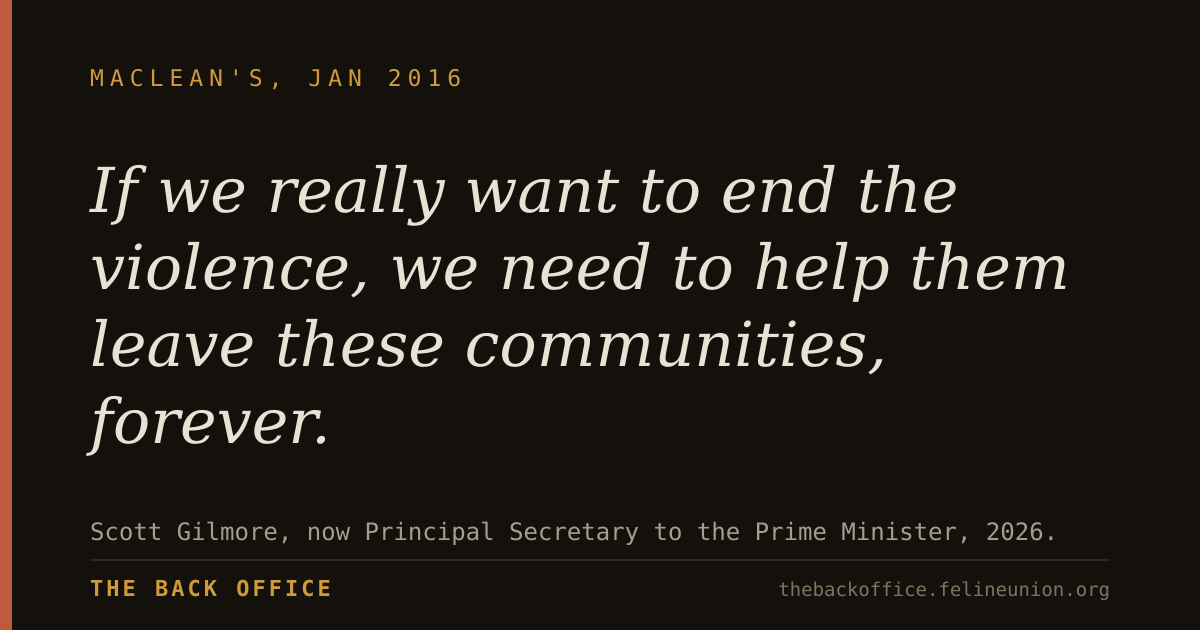
If we really want to end the violence and depravation[sic] that plagues Canada's remote Aboriginal communities, we need to help them leave these communities, forever. And if we are still not ready to do that yet, then the least we can do to help is to send them a backhoe as they keep digging graves.Scott Gilmore, Maclean's, Jan 27 2016
Strip the compassion from the wording and the content is the White Paper's: empty the community, relocate the people, permanently. What 1969 proposed as law and the back office pursued as procedure, Gilmore now proposes as mercy.
Sources: Maclean's · Gilmore follow-up · CanadaLand (Chelsea Vowel)
2020 – 2026
The return denied without a border
Sold as a housing shortage
Palestinian refugees have a named Right of Return whose implementation has been denied. Canada's version can be operationalized without naming a prohibition. An Indigenous person may remain legally free to stay in or return to a home community while the material condition that makes either choice real - a home - is withheld.
Karen Nanook of Taloyoak, Nunavut, told CBC in August 2026 that she had spent two decades waiting for public housing and was losing hope. The individual account is hers. The institutional architecture is confirmed by the Auditor General.
As of 31 March 2024, Nunavut's 25 community spreadsheets contained 3,348 applicants who had already been waiting an average of 4.5 years. That is not the average time required to receive a home. The Nunavut Housing Corporation could not calculate that number because it lacked adequate allocation data. It could not consistently consolidate the lists, identify elders and applicants with disabilities, demonstrate regular reviews, or know whether homes were going to those most in need.
Taloyoak had a target of 60 new public-housing units. Twenty had been started in 2023–24. None of those twenty was complete by the audit cutoff. The plan counted starts as progress before a tenant could open a door.
Regina shows the administrative failure from the opposite direction. Saskatchewan Housing Corporation records obtained through freedom-of-information requests showed 3,161 vacant units province-wide in 2022. Regina accounted for 691 of them: 691 vacant homes in a local portfolio of 2,986, or roughly 23 per cent.
The later audited snapshot confirms that this was not a stray count. In May 2024 the Regina Housing Authority managed 3,003 rentable social-housing units. The Saskatchewan Provincial Auditor found 534 vacant - 17.8 per cent, or roughly one home in six - while 404 households were waiting. Only 170 vacant units were available to rent. The other 364, 12.1 per cent of the entire rentable portfolio, were out of service and in need of repair; 73 were undergoing major repair. From 2019 through 2024, Regina had Saskatchewan's highest level of vacancies, ranging from approximately 16 to 25 per cent.
The burden is not demographically neutral. Indigenous people were 10.4 per cent of Regina's population in the 2021 census; Saskatchewan officials later cited Indigenous households as 21.3 per cent of households in core housing need. First Nations people comprised 60.3 per cent of Regina's Indigenous population. The available audit does not publish the Indigenous identity of Regina Housing Authority tenants or applicants, so it cannot establish that First Nations people are the largest recipient group. What the public figures do establish is disproportionate need - and a consequential demographic fact the housing administrator does not report in the record examined here.
The distinction matters. Nunavut has a profound supply shortage compounded by an administration unable to account reliably for the queue. Regina had hundreds of existing public units unable to house anyone because the owner had not kept them in service. One system administers scarcity. The other manufactures additional scarcity out of capacity it already owns. In both, the final public product is the same: a person waits while government calls the inventory a housing program.
This is how a right can be denied without a checkpoint. The person remains formally free to come home. The house that would make return possible never arrives. Departure can then be described as voluntary because the state never issued an order to leave. “You may return” becomes administratively compatible with “there is nowhere for you to live.”
The comparison is a mechanism, not an equivalence. The Palestinian and Canadian cases arise from different histories, laws, territorial regimes, and state actions. The Taloyoak record does not prove that housing scarcity was designed to empty the community. It shows the operational question the relocation argument makes unavoidable: when Canada does not maintain the conditions required to stay or return, how voluntary is leaving?
Sources: CBC, “This Taloyoak, Nunavut, woman has spent 2 decades waiting for housing and is losing hope,” Aug 6 2026 · Auditor General, Public Housing in Nunavut (2025) · CKOM, SHC records obtained through FOI (2023) · Saskatchewan Provincial Auditor, Planning for Social Housing Units in Regina (2024) · Saskatchewan Public Accounts Committee, Oct 15 2025 · Statistics Canada, Regina Indigenous population (2021) · UN General Assembly Resolution 194 (III) · ICCPR, article 12(4)
2015 – 2024
Reconciliation - White Paper 2.0
Sold as reconciliation and rights
The modern vocabulary is "self-government," "reconciliation," and the United Nations Declaration on the Rights of Indigenous Peoples (Bill C-15). Diabo argues these are the same apparatus wearing its most flattering costume yet. The land-claims and self-government agreements, he writes, "all require the termination of Indigenous rights for some land, cash and delegated jurisdiction," converting nations into subordinate units:
[Canada aims to] convert Indian Act Bands into fourth-level Indigenous governments… lower in status than the federal, provincial, and municipal orders - turning Indigenous peoples into ethnic minorities as Indigenous-Canadians.Russ Diabo, 2021
He names it directly in his own section heading: "White Paper 2.0 - Termination by Municipalization." His 2024 title is blunter still: Reconciliation is Re-Colonization.
Sources: russdiabo.com · Georgia Straight
2026
The apex - the author reaches the office
Sold as public safety
On July 22, 2026, the man who published the relocation argument becomes Principal Secretary in the Prime Minister's Office. APTN reports the appointment under the headline "Carney's pick for advisor Scott Gilmore not sitting well with First Nations advocates," reproducing the backhoe passage as the basis for their alarm.
The argument that began as a defeated bill, survived as a claims desk, and returned as a magazine column has now completed its journey. It sits at the top of the office that sets the national agenda. The costume this time is the least arguable virtue of all: ending violence, keeping people safe.
Sources: APTN News · Globe and Mail · appointment record
1962 – 2009
The superintendent's son
The office as a family occupation
The apparatus is not only ideological. It has been, for the family now at its apex, an occupation. The Prime Minister's father, Robert James Carney (1933–2009), was principal of the Joseph Burr Tyrrell federal Indian day school in Fort Smith, Northwest Territories, from 1962, and Chief Superintendent of Schools for the Territories from 1969 to 1971. He ran the schooling arm of the same system.
The precise record matters, because overstatement is what lets the record be dismissed. It was a day school, not a residential school - though Indigenous children boarding at Fort Smith's residential institutions attended it. In a 1965 CBC broadcast the elder Carney described a program for children he called "culturally retarded." He later became a University of Alberta professor whose scholarship is genuinely mixed: a 1991 study documenting abuse allegations across Western Arctic schools and a 1996 submission to the Royal Commission on Aboriginal Peoples, alongside a habit of speaking well of the schools that has since made his work useful to residential-school denialists.
Asked about it in 2025, Mark Carney answered: "I love my father, but I don't share those views, to be absolutely clear."
The point is not inherited guilt. It is that the schooling arm, the claims desk, and the 2026 advisory chair are the same office across three generations of one household. Take the children. Extinguish the title. Empty the community.
Sources: CBC · CBC (Carney's response) · ActiveHistory
Three arms of one office
The children - the schooling arm
Residential and day schools, and later the histories written to soften them. Take the children.
The title - the land arm
The comprehensive-claims desk built in the mid-1970s, exchanging rights for certainty. Extinguish the title.
The community - the relocation arm
"Help them leave, forever," carried in print to the door of the PMO in 2026. Empty the community.
Three arms, one objective, changing its costume for whatever virtue each decade cannot say no to. That is the continuity. It is documented, not asserted - every station above rests on the state's own records or on the analyst, Russ Diabo, who has tracked the paper trail for forty years.
What this file does not claim
On Gilmore. He framed relocation as voluntary - "those who want it" - not as forced removal. The Métis writer Chelsea Vowel, who first surfaced the backhoe line, reads it as rhetoric for dramatic effect, not a literal proposal to dig graves. This file does not accuse him of proposing mass graves or forced relocation. The charge is narrower and it is his own: that he made permanently emptying Indigenous communities the centrepiece of what he called help.
On the Carneys. Robert Carney ran a day school, not a residential school, and did document abuse as well as minimize it. Mark Carney has disavowed his father's views on the record. The section is about an institutional lineage, not inherited guilt.
On Diabo. "Termination" is Diabo's characterization, argued over four decades. Government sources corroborate the scaffolding - the dates, the offices, the extinguishment-for-certainty language - but the normative reading is his, and it is presented as his.
On Kanesatake. Diabo’s causal account is authoritative Indigenous political analysis. The federal record is used to expose the intervention’s machinery, not to place a federal burden of proof over his knowledge of Mohawk political history.
On Taloyoak and Palestine. The comparison is between mechanisms, not histories or legal regimes. Nanook's reported wait and the audit's findings do not prove that housing scarcity was designed to force relocation. Palestinian refugees face an expressly articulated and persistently denied return claim. The Canadian mechanism examined here is material prevention: formal freedom to stay or return can coexist with no available home through which to exercise it.
On Saskatchewan and Regina. The 3,161 figure is province-wide and describes 2022 SHC records reported after a freedom-of-information request. Regina's 691 vacancies were part of that total. The later audited Regina snapshot is 3,003 rentable units in May 2024, of which 534 were vacant, 364 out of service for repairs, and 170 available to rent. “Vacant,” “available,” and “out of service” are not interchangeable, and figures from different dates should not be merged.
On Indigenous recipients. Public census and core-housing-need figures establish disproportionate Indigenous need in Regina. They do not establish the identity distribution of Regina Housing Authority tenants or applicants. This file does not describe First Nations people as the largest recipient group without that administrative dataset. It uses the current term “Indigenous”; “Aboriginal” appears only where historically necessary or in the title and language of an older source.
Sources
Share the file - twelve tiles
Tap Share to send a tile to your phone's share sheet with the card image attached; or post to X or Bluesky, or save the PNG to attach anywhere.